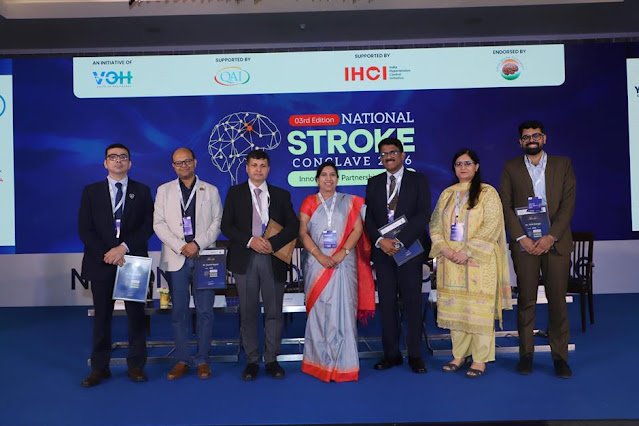

New Delhi, May 6, 2026: India’s
stroke care landscape is at a critical juncture, with nearly 1.8–2 million new
cases reported annually and less than 15% of patients reaching hospitals within
the golden treatment window. Stroke remains a leading cause of death and
long-term disability, reflecting significant gaps in awareness, timely access,
and healthcare infrastructure.
Addressing this challenge, the VOH National Stroke
Conclave, endorsed by the Indian Stroke Association and supported by the
India Hypertension Control Initiative and Yatharth Super Speciality Hospital,
brought together leading neurologists, policymakers, and healthcare experts in
New Delhi. The conclave, an initiative by Voice of Healthcare, focused on
driving actionable strategies to strengthen stroke care across India.
Setting the tone, Dr. Naveen Nishchal, Founder, Voice
of Healthcare, highlighted infrastructure gaps, stating, “There remains a
significant gap in stroke care across tier 3 cities, driven by a shortage of
neurologists and specialised infrastructure… many regions still lack even basic
facilities like CT scan machines.”
Highlighting the scale of the challenge, Dr. Vikram Huded,
President, Indian Stroke Association, said, “India records nearly 1.8
million stroke cases annually, yet access to timely treatment remains
critically limited. Fewer than 5% of eligible patients receive thrombolysis.”
He emphasized the need for faster response systems to improve outcomes.
Dr. Arvind Sharma,
Secretary, Indian Stroke Association, stressed that “advancing stroke care
in India demands the convergence of innovation, strategic partnerships, and
supportive policy,” while calling for a more coordinated, system-wide
approach.
Offering a global perspective, Dr. Jeyaraj Pandian,
President, World Stroke Organization, highlighted regional disparities and
pointed to telemedicine and AI as key enablers in expanding access.
From an industry standpoint, Amit Singh, Group CEO,
Yatharth Super Speciality Hospital, stated, “stroke is increasingly
affecting younger populations,” underscoring the need for awareness, early
recognition, and scalable care models.
Discussions at the conclave spanned the full continuum of
stroke care—from policy and prevention to acute management and long-term
recovery. Experts emphasized integrating stroke into national NCD programs,
strengthening financing frameworks, and addressing the gap between policy
intent and implementation.
A strong focus was placed on prevention and early diagnosis,
including better control of hypertension and diabetes, improved screening, and
FAST awareness. In line with this, Voice of Healthcare has also launched a
nationwide hypertension awareness campaign under the banner ‘BP Ko Halke
Mai Na Le’, highlighting the silent risks of uncontrolled blood pressure,
which can lead to serious conditions such as stroke, cardiac arrest, and kidney
failure, while encouraging people to take early action.
Clinical discussions addressed reducing treatment delays,
improving access to thrombolysis and thrombectomy, and strengthening emergency
response systems and care pathways. Experts also highlighted the growing role
of digital health, with AI and tele-stroke networks improving access,
particularly in underserved areas.
A key highlight was the launch of the National Stroke
Patient Support Network, led by Dr. Kunal Bahrani, aimed at creating
a structured continuum of care from emergency response to long-term recovery.
Dr. Bahrani noted, “Stroke care does not end at
discharge. A structured recovery pathway is essential to improving long-term outcomes
and quality of life for patients.”
The conclave concluded with a strong consensus on the need
for coordinated action across policy, clinical practice, innovation, and
patient-centric care systems to improve stroke outcomes in India.