
Imagine
you bought a beautiful gold necklace five years ago for a family wedding. You
remember the rate of gold being
significantly lower back then. Today, as you look at the news and see the gold
price in India touching new highs, you decide it is the perfect time to
liquidate that piece for some urgent business capital or a home renovation.
But,
when you go and raid the jewellery store, the price that they give you is so
low that it is impossible that the “spot price” that you saw on your
mobile screen one hour ago. You are struck with confusion, maybe even
frustration. Are the jeweller’s actions unfair?
This
is a common experience for many Indian households. Understanding the gap
between the “market rate” and the “in-hand value” is
essential for making sound financial decisions. As a veteran in the financial
advisory space for over two decades, I have seen many individuals lose out on
value simply because they didn’t understand how the gold price is restructured
during a resale.
The Anatomy of the Gold Price Gap
When
you see a gold price in India advertised on news channels or financial
websites, you are usually looking at the “Spot Price” or the
“IBJA (Indian Bullion and Jewellers Association) Rate.” This is the
price for 24-karat (99.9% pure) raw gold bullion. When you sell used jewellery,
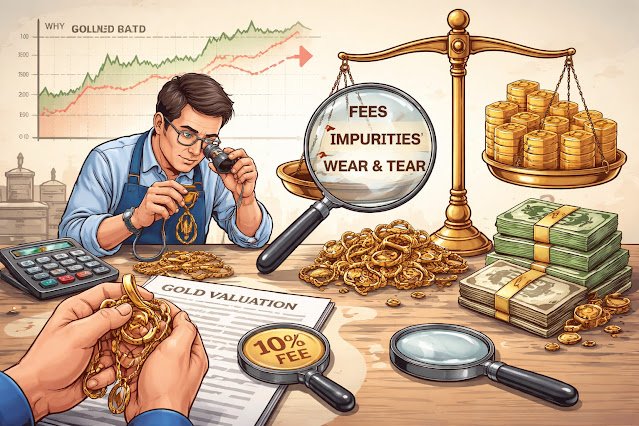
you aren’t selling raw bullion; you are selling a finished product. Here is why
the numbers don’t match up.
1. The Purity “Karat”
Factor
Most
jewellery is made of 22K or 18K gold because 24K is too soft for intricate
designs. If your piece is 22K, it only contains 91.6% pure gold. Naturally, a
buyer will only pay for the actual gold content, not the alloys mixed in to
make it durable.
2. Deduction of “Making
Charges” and GST
When
you bought the jewellery, you paid for the craftsmanship, known as making
charges, which can range from 8% to 25% of the gold value. You also paid 3% GST
on the total.
Important
Note:
Making charges and GST are “consumption costs.” They add value to the
beauty of the piece, but they carry zero resale value. A buyer is only
interested in the raw gold content, not the labour that went into it years ago.
3. Melting and “Wastage”
Charges
To
recycle your gold, a buyer must melt it down and refine it. During this
process, a small percentage of metal is inevitably lost (oxidation or removal
of impurities). Most buyers deduct a wastage charge (typically 2% to 5%) to
cover this loss and the cost of refining.
Comparison: Buying vs. Selling 10
Grams of 22K Gold
To
make this clearer, let’s look at a hypothetical scenario based on a market gold
price of ₹75,000 for 10 grams of 24K gold.
|
Factor |
Buying |
Selling |
|
Base |
₹68,700 |
₹68,700 |
|
Making |
+ |
Excluded |
|
GST |
+ |
Excluded |
|
Wastage/Melt |
Included |
– |
|
Net |
₹79,252 |
₹66,639 |
As
you can see, there is a significant “spread” between what you pay and
what you get back.
Should You Sell or Pledge? The
Liquidity Dilemma
Should
you be in a situation where you require money very quickly, selling your gold
can seem like the fastest way out. But you have to question whether this is a
lasting need or just a passing one.
When
you sell, you lose the asset forever. If the gold price in India continues to
rise, as it historically has, you miss out on that future appreciation. This is
where a gold loan becomes
a strategic alternative. When you opt for a loan, you still own your gold. You
are basically “leasing” cash from your property.
A
practical choice for many is Muthoot Finance, which has been ranked as India’s
No. 1 Most Trusted Financial Services Brand for eight consecutive years by the
TRA Brand Trust Report 2024. With a legacy built over an 800-year family
business history, they offer a way to unlock liquidity without permanently
parting with your family assets.
Recommendations for Maximum Value
In
case selling is the only option, here are some of the things you can do to
avoid being undervalued:
· Check
the Hallmarking: The BIS (Bureau of Indian Standards) hallmark is proof
of purity. A buyer may deduct a higher “melting loss” if the gold is
not hallmarked.
· Clean
the Jewellery: Dirt and oils can add weight. Make sure the item is
clean before it goes on the scale.
· Insist
on an Electronic Purity Test: Try to avoid the old
“touchstone” method. Modern X-Ray Fluorescence (XRF) machines give an
accurate purity reading without damaging the metal.
· Compare
the Buy-Back Policy: Check if the original jeweller has a
buy-back policy. Often, they offer their own pieces at a slightly better rate.
Making the Right Choice
for Your Future
The
decision to part with gold is often emotional and financially heavy. Whether
you are looking to reinvest or settle a debt, transparency is your best friend.
Always remember that the rate of gold you see on the news is a starting point,
not the final destination.
If
your need for cash is temporary, a loan ensures your assets stay safe. For
instance, Muthoot Finance serves over 2.5 lakh customers daily and protects
assets with a world-class 7-layer security system, including 24/7 monitoring
and high-tech strong rooms. This ensures your gold stays secure while it
continues to appreciate in value.