
Kofluence’s
Decoding Influence 2026 maps how AI, regulation, creator commerce, and
performance accountability are reshaping the business of influence in India.
Bengaluru,
India, 14th May 2026 : Kofluence, India’s leading Ad-Tech influencer
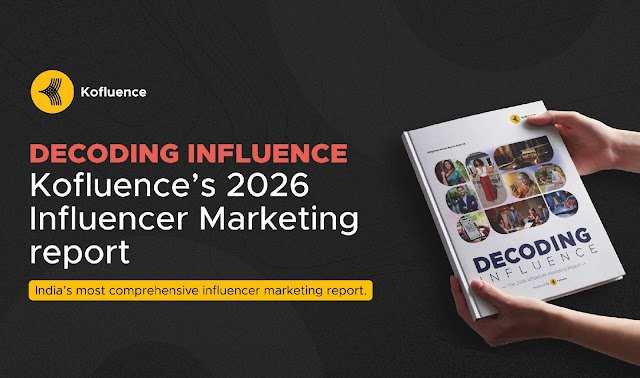
marketing platform, today released Decoding Influence: Annual Research Report
2026. Drawing on data from over 2 million creators, 1,000+ surveys, and
in-depth interviews with 50+ industry professionals, the flagship study
documents a structural shift in India’s creator economy. The landscape has
transitioned entirely from an experimental phase into a formalised industry
defined by infrastructure, standardised processes, and regulatory governance.
India’s
influencer marketing sector is valued at ₹3,000-3,500 Cr in 2025, sustaining a
22% CAGR from that base, and is projected to reach ₹4,500-5,000 Cr by 2027,
driven by deeper brand integration, creator professionalisation, and the
institutionalisation of influencer marketing initiatives. This expansion is
driven by the formalisation of influence — transforming creator partnerships
into measurable, business-critical operations.
Leadership
Quotes
“What
this report captures is a market that has crossed a structural threshold. With
15% of India’s active creator base now registered as formal business entities,
and brands linking influencer marketing directly to revenue targets, influence
is no longer a soft channel. India is not following global best practices in
creator commerce — it is writing them.” — Sreeram Reddy Vanga, CEO and
Co-Founder, Kofluence
“AI
has done what most technology promises and rarely delivers: it has compressed
the production overhead that was preventing India’s creator class from
operating at business scale. The governance question is now the defining one.
ASCI disclosures, SEBI scrutiny, DPDP compliance — these are not obstacles.
They are the structural filters that will separate the durable from the
disposable.” — Ritesh Ujjwal, Co-Founder, Kofluence
Key
Insights from the Annual Research Report 2026
1.
The Formalisation of the Creator Class
India’s
creator base spans 4.0M-4.4M+ active professionals, with Instagram serving as
the primary infrastructure for 3.3-3.7 million creators. The defining metric of
2026 is business incorporation: 15.2% of creators are now registered as a
business entity or GST individual. This establishes a new entry barrier for
institutional brand partnerships, making the GST-registered creator the new
baseline for enterprise engagement. Within this expanding base, 61.1% of all surveyed
creators operate in the Nano tier (1K-10K followers), providing highly targeted
community engagement. Specifically, 15.2% of India’s active creators are now
registered as a business entity or GST individual, representing the new minimum
threshold for institutional brand partnerships.
2.
Regional Infrastructure Driving Growth
With
India having crossed 900 million internet users, Tier 2, 3, and 4 cities have
become the operational centre of gravity for the creator economy. Over 62% of
creators report an increase in regional and vernacular language briefs from
brands, signalling a systematic shift toward hyper-local strategies. The
performance case is direct: In Metro cities, average engagement rates range
from 3% to 4%, with average cost per campaign between ₹3.8L and ₹4.5L. In Tier
2 cities, average engagement rates improve to 3.5% to 4.5%, with average cost
per campaign dropping to ₹1.3L to ₹1.6L. In Tier 3 and 4 cities, average
engagement rates reach their highest at 4.5% to 5.5%, while average cost per
campaign falls to ₹35K to ₹90K. This data is sourced from Kofluence ARR 2026
Platform Data and BCG India Consumer Markets Report.
3.
Brand Accountability and Revenue Integration
Brand
accountability for influencer spend is accelerating. 13.3% of brands now
directly link influencer marketing spend to formal revenue targets, with a
further 46.4% applying performance accountability on a campaign-by-campaign
basis. 62% of brand professionals confirm that long-term creator partnerships
deliver superior ROI compared to one-off campaigns. Platform investment remains
heavily concentrated: 93.1% of brands prioritise Instagram as their primary
influencer channel, with e-commerce leading sectoral spend at 23%, followed by
FMCG at 19%. Specifically, 93.1% of brands prioritise Instagram as their
primary influencer marketing channel, making it the non-negotiable platform for
any scaled creator programme in India.
4.
AI as Operational Infrastructure
Technology
has standardised content production and campaign management at scale. Among
creators, 59% regularly or sometimes use AI tools for content ideation,
creative design, trend analysis, and scheduling. Only 17.3% of creators never
use AI tools — a figure that continues to decline as technology becomes
embedded in daily workflows. Brands are deploying AI across creator discovery,
performance forecasting, and automated reporting, with 61% of brands actively
exploring tech platforms to streamline influencer campaigns. Specifically, 59%
of India’s active creators regularly or sometimes use AI tools, with content
ideation leading adoption at 64.4%, followed by creative design at 31.9% and
trend analysis at 28.1%.
5.
Regulation Formalising the Industry
SEBI’s
crackdown on finfluencers, ASCI’s updated disclosure mandates, and the Digital
Personal Data Protection (DPDP) Act are collectively separating professionals
from participants and pushing the industry toward accountability. Compliance is
no longer a constraint on creativity — it is the foundation for institutional
trust. Brands and creators who internalise this early will build durable
advantages as enforcement tightens.
Report
Availability
The
full Decoding Influence: Annual Research Report 2026 is available for free
download at the website link.
About
Kofluence
Kofluence
is India’s leading Ad-Tech influencer marketing platform, powered by a
full-stack AI platform that enables both brands and content creators to
capitalise on the value of their social influence. A verified Meta and Google
partner, Kofluence operates a hybrid Managed Services and SaaS model with
performance-linked creator programmes — including CPA and ROAS-based campaign
structures — across BFSI, D2C, FMCG, and short-form video verticals.
The
platform has powered campaigns for 600+ clients across 30 sectors, including
Domino’s, HUL, ITC, Netflix, L’Oréal, Coca-Cola, Swiggy, Meesho, Flipkart,
Bajaj Finserv, and TVS. With a network of over 750,000+ influencers spanning
30+ languages and a reach of more than 7.5 billion, Kofluence brings unmatched scale
and diversity to India’s creator economy. Recognised in Forbes’ Select 200
Companies With Global Business Potential, Kofluence is ISO-certified, verified
by Meta and Google, and a proud member of ASCI.
Report
Download website link –
Decoding Influence 2026
Editorial
Notes
Data
Sources and Methodology
●
Quantitative analysis drawn from over 750K+
creators active on the Kofluence platform.
●
Survey-Based Research: 1,000+ creator
respondents and 50 brand managers, fielded Q1 2026 via digital forms. Creator
respondents filtered for a minimum two-year monetisation track record.
●
In-depth interviews with 50+ industry
professionals — senior brand marketers, platform strategists, and established
creators.
●
Secondary research: DataReportal Digital India
2026 | Statista India Social Media 2026 | EY-FICCI M&E Report 2026 | BCG
India Consumer Markets Report.
●
All financial figures in Indian Rupees (INR).
YoY comparisons use 2024 as base year. Industry size estimates are Kofluence
estimates based on desk research, expert discussion, and industry analysis.
●
Engagement rate figures: survey data
cross-validated with Kofluence platform campaign data. Confidence interval
within ±0.3%.